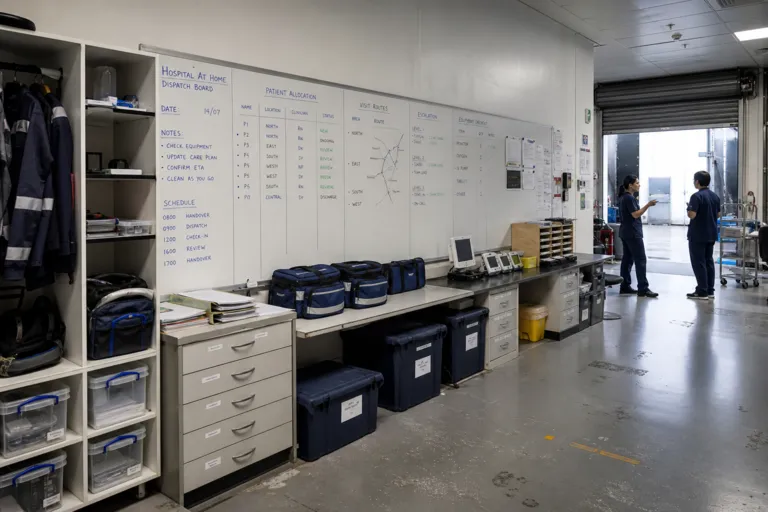
Home-based acute care is moving from experimentation into a clearer growth story across Asia Pacific. In this context, Home-Based Care Models APAC leaders are using “hospital at home” (also called Hospital in the Home, virtual wards, or virtual hospitals) to deliver acute, inpatient-level services in a patient’s residence. These models use tools such as remote monitoring, in-home clinical visits, and telehealth support to substitute for a traditional hospital admission. The Asia Pacific hospital-at-home market is forecast to rise from US$ 8,253.7 million in 2025 to US$ 16,825.9 million by 2034, reflecting a CAGR of 8.3% from 2026 to 2034. That trajectory supports a wider regional push to rebalance care away from hospitals without treating routine home health or hospice as the same thing.
The hospital-at-home trend in APAC sits inside a much larger home healthcare ecosystem. One regional estimate values the Asia-Pacific home healthcare market at USD 93.24 billion in 2025, rising to USD 103.94 billion in 2026 and projected at USD 247.95 billion by 2034, at a CAGR of 11.48% from 2026 to 2034. Another outlook projects Asia Pacific home healthcare growing from USD 105.65 billion in 2025 to about USD 343.08 billion by 2035, at a CAGR of 12.50%. Within that broader market, component splits highlight where operational focus often lands: one 2025 breakdown assigns 58% to services and 42% to equipment, linking demand to in-home nursing, rehabilitation, long-term support, and home monitoring devices and portable diagnostic tools.
How APAC Programs Are Operationalizing Acute Care at Home
Australia is frequently described as a mature reference point, with established state-funded Hospital in the Home (HITH) programs, including in New South Wales and Victoria. These services deliver acute care at home for conditions such as infections and respiratory conditions using multidisciplinary teams, remote monitoring, and telehealth. Queensland’s virtual COVID-19 HITH service scaled to over 3,240 admissions, and Victoria launched a six-month virtual hospital pilot in 2025 to support over 250 patients as a way to ease ward pressures. Elsewhere in the region, Singapore and Japan are described as running pilots that integrate remote patient monitoring and AI for chronic-acute transitions, while India and China explore community-based models aimed at reducing hospital overload.
Several sources tie this shift to both need and enabling infrastructure. One regional summary links momentum to rapid aging demographics, urban-rural healthcare disparities, and digital health advancements, while also noting APAC adoption remains fragmented and still emerging compared with developed economies. Another APAC-focused analysis highlights that the post-pandemic period has normalized virtual consultations and remote patient monitoring across the region, reducing cultural and logistical barriers that previously slowed adoption. It also frames Australia as bringing decades of operational experience through HITH, while China is leveraging national policy ambition and digital infrastructure at scale. Industry gatherings such as the Global Hospital in the Home Summit (convened by the Hospital in the Home Society of Australasia) are described as focusing on workforce models, technology standardization, and value-based reimbursement for scaling home-based acute care beyond metropolitan areas.
Global signals provide context but should not be read as APAC performance. In the United States, demand has been shaped by regulation: the CMS Acute Hospital Care at Home (AHCAH) waiver was extended through September 30, 2030 under the Consolidated Appropriations Act, 2026. As of early 2026, CMS reported 366 hospitals across 139 health systems in 37 states approved to provide acute hospital care in patients’ residences, treating tens of thousands of patients. A separate global market estimate puts the hospital-at-home market at USD 8.0 billion in 2025, projected to reach USD 35 billion by 2035 at a CAGR of 15.9% (2026–2035). For APAC decision-makers, these points mainly serve as proof of scalability when reimbursement and operating models align, while local execution still depends on each country’s policies, workforce capacity, and digital infrastructure.
What is driving acute services to move out of hospitals in Asia Pacific?
How fast is the Asia Pacific hospital-at-home market expected to grow?
What are real examples of hospital-in-the-home scale in APAC?
In practical terms, what do Home-Based Care Models APAC rely on to deliver acute care?
What does the US experience show about scaling hospital-at-home, and why is it only context for APAC?