Remote Patient Monitoring Thailand is increasingly discussed as part of a broader shift toward care that happens at home, not only in hospitals. Remote patient monitoring (RPM) is described as a subset of telehealth that uses digital technologies to collect and transmit patient data, such as blood pressure, heart rate, or blood glucose, from home to healthcare providers. In Thailand, telemedicine is already segmented by service type into teleconsultation, RPM, teletherapy, and health information exchange (HIE). Nexdigm notes teleconsultation currently holds a dominant share, showing that remote care behavior is already established and creating a natural pathway for monitoring services to deepen that relationship over time.
Thailand’s healthcare structure also helps explain why decentralized models matter. Thailand Medical Hub intelligence describes a market shaped by three forces: a government Medical Hub policy with a 10-year horizon and five strategic pillars, a demographic shift toward a super-aged society, and active investment in digital health infrastructure across public and private hospital networks. It also states the public sector makes up approximately 80% of the country’s nearly 1,300 hospitals, administered by the Ministry of Public Health and anchored by the Universal Coverage Scheme. That mix can favor scalable, system-wide approaches, where continuous monitoring supports follow-up care beyond facility walls.
Why Market Momentum Favors Home Monitoring
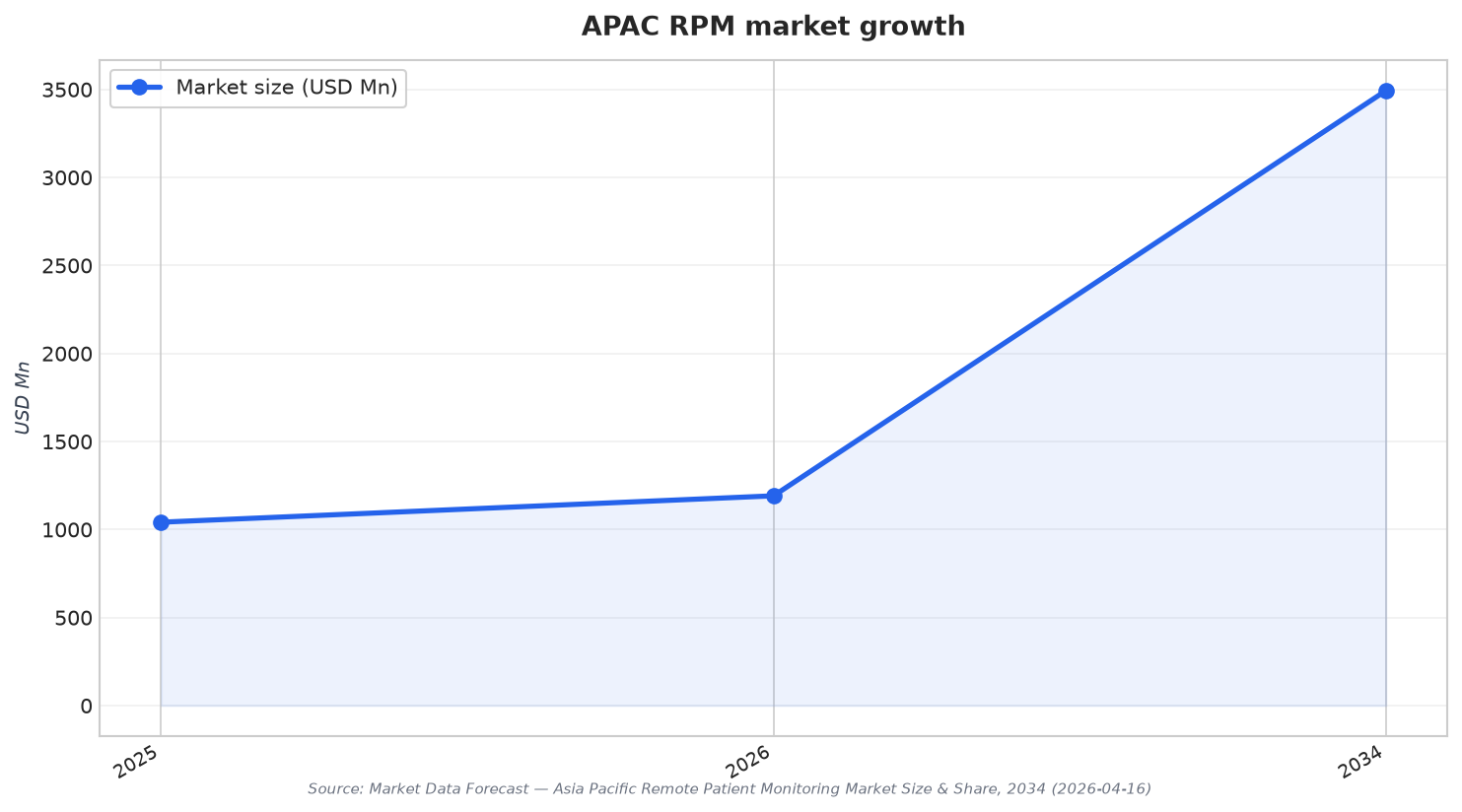
Regional market numbers reinforce the direction of travel, but they should be read as Asia-Pacific context rather than Thailand-only facts. Market Data Forecast values the Asia Pacific RPM market at USD 1,041.77 million in 2025, estimates USD 1,191.68 million in 2026, and projects USD 3,493.53 million by 2034, with a 14.39% CAGR from 2026–2034. Another source, SNS Insider, frames the broader RPM market at USD 39.97 billion in 2025 and expects USD 132.00 billion by 2035, at a 12.69% CAGR. Together, these figures align with the idea that home-centered monitoring is becoming a mainstream delivery model, not a niche tool.
Several sources connect that market growth to the same care-delivery shift Thailand is navigating. SNS Insider explicitly ties growth to a “shift towards home healthcare,” describing patient and provider preferences for home care over hospitals and emphasizing home-based monitoring that reduces hospital burden while improving comfort. Grand View Research similarly points to growing preference for home healthcare and remote care services, describing how remote monitoring supports physicians in tracking vitals remotely, improving treatment adherence, and reducing hospital readmissions. Technavio adds that the market is shaped by decentralized care models and data-driven treatment plans, noting that some systems reduce administrative tasks by 30%, which matters when providers need to manage larger patient panels.
Within Thailand’s telemedicine landscape, adoption patterns suggest where RPM can fit next. Nexdigm identifies Bangkok as the leading city driving telemedicine growth due to well-established healthcare infrastructure and strong digital connectivity. It also notes that, by end user, healthcare providers have a dominant share because hospitals and clinics integrate telemedicine to extend services remotely and improve operational efficiency. Thailand Medical Hub intelligence also highlights commercial opportunities tied to aging and chronic disease management, and it explicitly frames an addressable market for remote monitoring, telemedicine, and AI-assisted diagnostics. Taken together, the signal is clear: as remote interactions mature, monitoring at home can become a more routine layer of care.
What does remote patient monitoring mean in this context?
How does Thailand’s hospital system shape the case for home-based care?
What Asia-Pacific figures show momentum for remote monitoring?
How fast is the broader remote monitoring market growing globally?
How is Remote Patient Monitoring Thailand connected to telemedicine adoption?