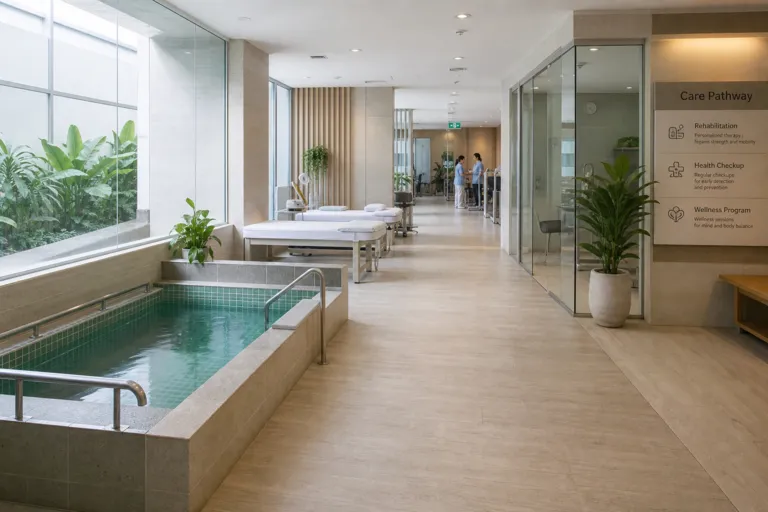
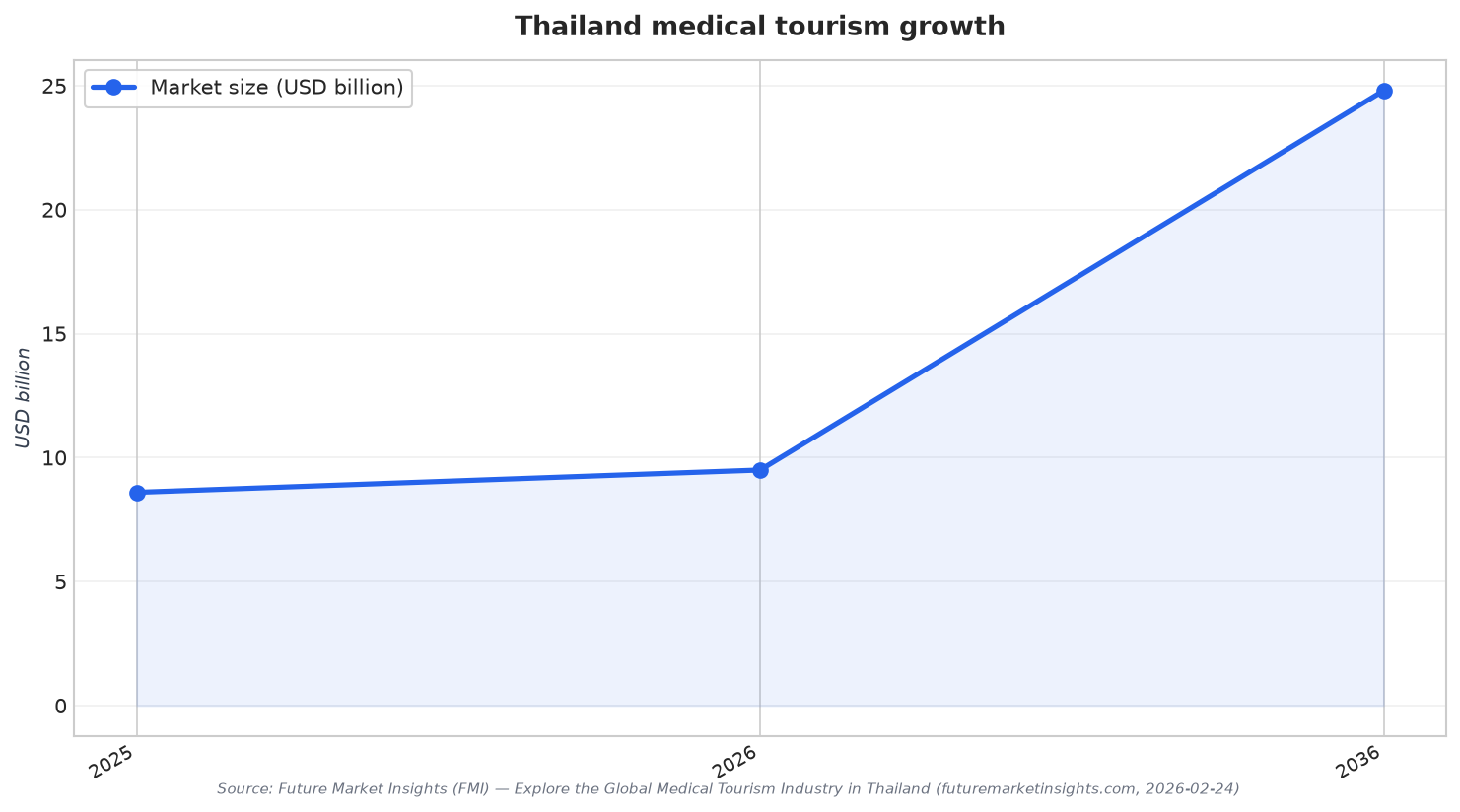
Wellness Medical Tourism Thailand is no longer defined only by quick elective procedures. Future Market Insights (FMI) describes the sector as evolving from a cost-driven destination into a premium global healthcare hub focused on complex and high-acuity treatments. That shift sits alongside a clear growth narrative: FMI estimates Thailand’s medical tourism industry generated USD 8.6 billion in 2025, rising to USD 9.5 billion in 2026, with a projection of USD 24.8 billion by 2036 at a 10.1% CAGR. The mix is changing, too. While cosmetic surgery remains significant, the direction of travel is toward care that raises average revenue per patient and supports more comprehensive, longer itineraries.
The numbers show both continuity and change. FMI states cosmetic surgery accounts for 25% of the market in 2026, reflecting Thailand’s long-standing reputation in aesthetic procedures. At the same time, FMI points to increasing demand for oncology services, robotic-assisted surgeries, and other technologically advanced interventions, reinforcing a value-over-volume model. Another signal of this “flight to quality” appears in FMI’s estimate that BDMS reported an 11% increase in international patient revenue in 2024, driven by high-complexity cases from Qatar and China. In this environment, Thailand’s proposition becomes less about one procedure and more about a planned episode of care.
Wellness Integration Is Changing the Typical Medical Trip
One of the clearest signs that Thailand is moving beyond elective-only positioning is the integration of wellness with clinical delivery. FMI notes that hospitals are combining treatments with wellness programs, increasing patient stay duration and overall spending. Reporting on the broader destination brand, observers describe bundled offers that pair check-ups or procedures with beach stays, wellness retreats, or cultural excursions, contributing to longer average stays and higher per-trip spending than conventional leisure travel. This is reinforced by the service mix highlighted for international health tourists, which includes health screenings, executive medical checks, rehabilitation, Thai massage, herbal therapies, spa treatments, nutrition programmes, and mental wellbeing retreats.
Geography also supports the “medical plus wellness” transition. Bangkok and Phuket are identified by FMI as primary hubs, while MarkWide Research highlights Phuket’s beachfront recovery facilities capturing visitors explicitly traveling for treatment through wellness-integrated positioning that differs from Bangkok’s clinical environment. The wellness-led calendar is also becoming part of the economic narrative: a 2026 update notes the 20th Global Wellness Summit will be held in Phuket from November 10 to 13, 2026, expected to draw more than 600 delegates from over 30 countries and generate a minimum of 300 million baht in direct economic impact. These events help connect providers, payers, and wellness operators into a more coordinated visitor journey.
This evolution is happening inside a global boom, but local figures matter most for strategy. For context, one industry summary values the global medical tourism market at approximately USD 207 billion in 2026 and estimates 14 to 20 million patients cross borders annually for medical care. Against that backdrop, Thailand’s wellness economy is described as reaching around USD 43 billion in 2024, with USD 14 billion specifically attributable to wellness tourism spending. The takeaway for patients is that Thailand is building experiences around prevention, recovery, and longer stays, while still anchoring the offer in hospital capacity and advanced interventions. For providers, the opportunity is to design end-to-end pathways where clinical outcomes and wellness programming reinforce each other.
How is wellness-focused medical travel in Thailand moving beyond elective procedures?
What market growth figures are forecast for Thailand’s medical tourism industry?
How large is the cosmetic surgery segment in Thailand’s medical tourism market?
Why are Phuket and Bangkok important to Thailand’s medical and wellness travel positioning?
What is expected from the 2026 Global Wellness Summit in Phuket?