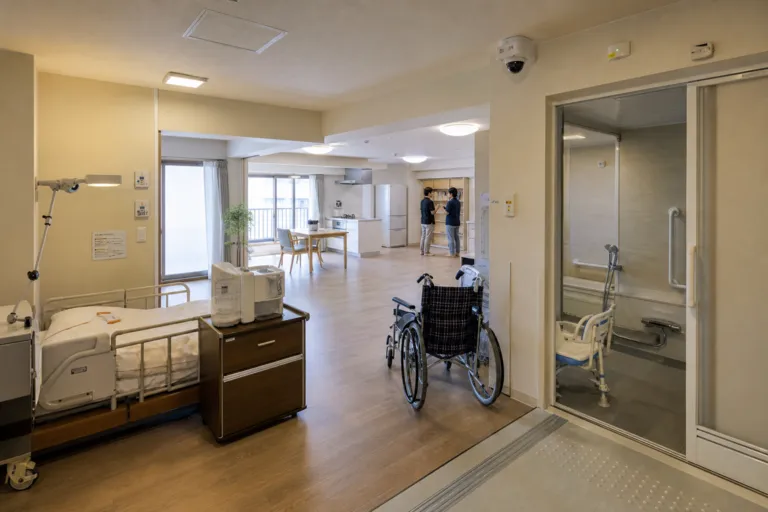
Home independence is becoming a practical design goal in Japan’s care ecosystem. In the Japan smart home market, Mordor Intelligence estimates market size at USD 11.77 billion in 2026, with a projection to reach USD 17.77 billion by 2031 at an 8.58% CAGR. The same report links demand to ageing-in-place needs and notes that Japan’s over-65 cohort reached 36.2 million in 2025. It also describes municipalities subsidizing motion sensors, fall-detection wearables, and voice-activated lighting so seniors can remain at home rather than relocate to care facilities. This direction connects housing, monitoring, and daily routines into a single home-first care pathway.
Home care is also expanding through medical and mobility equipment that fits domestic life. Future Market Insights estimates demand for homecare medical devices in Japan at USD 8.9 billion in 2025 and forecasts USD 16.9 billion by 2035, with a CAGR of 6.7%. The report frames growth around care outside hospitals, with home-use respiratory equipment, mobility aids, and monitoring systems that support independence. It also describes a healthcare system that encourages care outside hospitals, supported by telemedicine and remote patient monitoring that enable real-time data sharing with healthcare providers. These capabilities help shift ongoing needs into the home without treating the home as a clinical ward.
Smart Homes and Assistive Devices Are Converging at Home
Smart home adoption patterns show how quickly “assisted independence” is becoming a mainstream use case. Mordor Intelligence reports that smart appliances held a 27.43% revenue share in 2025, while security devices are forecast to expand at a 10.81% CAGR through 2031. Connectivity is led by Wi-Fi at 45.12% share in 2025, while Thread protocol is projected to grow at a 9.23% CAGR to 2031. Deployment is often simple: DIY installations commanded a 62.47% share in 2025 and are expected to grow at a 12.39% CAGR to 2031. NextMSC similarly describes Japan smart home trends shifting from convenience to assisted independence, including smart sensors, automated lighting, fall-detection, remote monitoring, and voice-controlled interfaces to support older residents.
Alongside smart homes, the assistive devices market is being pulled toward independence-focused, home-based tools. DataM Intelligence estimates assistive technology products at approximately 64.0% of Japan’s assistive devices market in 2025, equal to nearly USD 694.8 million. By 2033, this segment is projected to reach approximately USD 1,660.7 million, increasing share to about 69.0%. The same source attributes the segment’s dominance to the shift toward user-friendly devices used in everyday environments, including wheelchairs, smart mobility devices, hearing support products, daily living tools, and care-support equipment. It also highlights Honda’s Walking Assist system, which integrates motion sensing, motorized walking support, and data analysis for gait symmetry, walking speed, and range of motion, supporting technology-enabled rehabilitation.
Care delivery modernization is also visible in market projections for elder care technology itself. Global Reports Store values the Japan elderly care technology market at US 1.18 billion in 2025 and projects US 3.76 billion by 2033, expanding at a CAGR of 15.59. The report emphasizes themes that align with home independence and safer care, including fall prevention, dementia support, family-caregiver communication, AI-assisted care planning, privacy-preserving monitoring, and municipality-linked community care. Taken together, these signals show why Aged Care Technology Japan discussions increasingly center on the home as the primary setting, supported by devices, platforms, and connected workflows designed to preserve dignity and autonomy.
What is driving Japan’s push toward home independence in elder care?
How large is Japan’s homecare medical devices demand, and what is the forecast?
Which smart home adoption indicators matter for at-home ageing support in Japan?
What does the assistive technology segment look like in Japan’s assistive devices market?
How fast is the market for Aged Care Technology in Japan projected to grow?