
Cross-boundary care is becoming a practical option for many residents as Cross-Border Healthcare Hong Kong increasingly connects with providers across the Guangdong-Hong Kong-Macao Greater Bay Area (GBA). Research in Public Administration and Policy notes that Mainland providers, supported by state and big corporate investment and a massive domestic market, can offer high-quality services at a fraction of the cost found in Hong Kong’s private sector. The same work points to infrastructure improvements and policy developments that reinforce regional integration. This sits within the GBA initiative launched by the State Council of the People’s Republic of China in 2019 to enhance economic and social integration across 11 cities, including Hong Kong, Macao, and major Mainland cities such as Guangzhou and Shenzhen.
Policy direction also matters because Hong Kong and Mainland China operate different healthcare systems under the “One Country, Two Systems” scheme, as highlighted by an infrastructural study of cross-boundary access in the GBA. At the national-planning level, a BMC Health Services Research paper links cross-boundary cooperation to “Shaping a Healthy Bay Area” under the Outline Development Plan for the Guangdong-Hong Kong-Macao Greater Bay Area issued in 2019. It describes two major objectives: promoting cross-boundary healthcare cooperation and improving the quality and efficiency of healthcare services in the GBA. Together, these policy signals frame cross-boundary utilization by Hong Kong residents as a governance tool, not only an individual workaround.
What Is Accelerating Integration: Insurance, Direct Billing, and Digital Systems
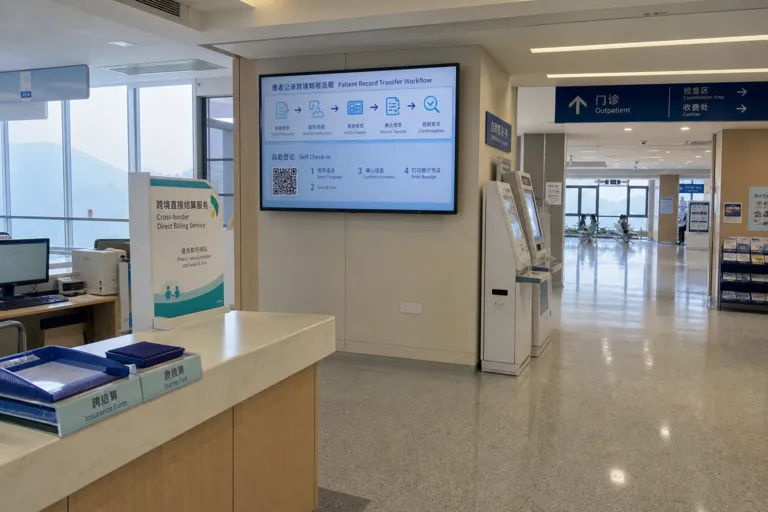
Insurance design and payment workflows are a major accelerator. A 2026 analysis report on GBA cross-border medical insurance describes a market shifting from traditional protection toward an integrated “insurance + medical services” model, supported by reduced policy barriers and increased population mobility. It states that the GBA has a permanent resident population of over 86 million and generated GDP exceeding RMB 14 trillion in 2025, creating potential demand for cross-border medical insurance products. The report says leading Hong Kong insurers, including Prudential, AXA, and AIA, are expanding medical networks in the Mainland and launching products that support “cross-border direct billing.” It also notes product designs enabling Hong Kong residents to claim expenses at Mainland tertiary hospitals or at Hong Kong-funded institutions such as The University of Hong Kong-Shenzhen Hospital.
Patient demand signals are also explicit in the same 2026 report. It states that the proportion of Hong Kong citizens who have sought medical treatment in the Mainland has reached 60% in recent years, described as more than 10 times higher than 15 years ago. The report adds that over 90% of GBA residents feel it is difficult to achieve true “freedom of medical choice,” which helps explain why cross-boundary options matter beyond price alone. Separately, Frontiers in Public Health summarizes drivers for Hong Kong residents seeking care in Mainland China as medical quality, efficiency, and cost, and calls for stronger collaboration across Shenzhen, Hong Kong, and the wider GBA through institutional mechanisms, welfare benefits, long-term follow-up, and health monitoring.
Digital platforms are becoming part of the integration story, especially for older adults. A ScienceDirect study argues there is a “digital turn” in regional integration and analyzes how digital healthcare platforms are reshaping cross-border healthcare services for Hong Kong older adults in the GBA. It identifies obstacles such as fragmented data flow policies, usability issues, and limited awareness, and argues these can be addressed by enhancing regional cohesion, improving accessibility, and fostering a sense of belonging in the GBA. The 2026 insurance report also points to technology-enabled process improvements, citing Hong Kong’s “eHealth” electronic health record interoperability and intelligent claims systems as tools that optimize cross-border payment and reimbursement, pushing experiences closer to seamless direct billing.
What is driving cross-boundary care choices for Hong Kong residents in the GBA?
How common is cross-boundary medical treatment among Hong Kong citizens?
What role does insurance play in cross-border care across Hong Kong and the Mainland?
What are the main digital barriers to cross-border healthcare services for Hong Kong older adults?
How is Cross-Border Healthcare Hong Kong tied to Greater Bay Area integration policies?