
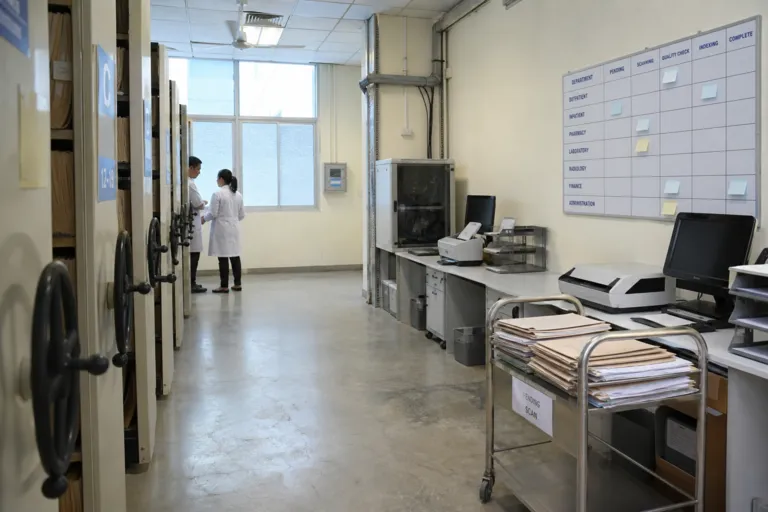
Hospital digital transformation in Vietnam is increasingly tied to the practical goal of reducing paper records and making care easier to manage. The government’s National Digital Transformation Program (Decision 749/QĐ-TTg) designates healthcare as a priority sector and targets 100% of healthcare facilities adopting electronic health records (EHR), e-prescriptions, and cashless payments by 2025, while also promoting a national health database and telemedicine platforms. At the same time, adoption is not only policy-driven. Vietnam’s digital healthcare market was described as reaching USD 815 million in 2026, with projections that it could grow to USD 1 billion by 2028 at a CAGR of 5.31%, signaling a maturing ecosystem after accelerated telemedicine adoption during 2020–2024.
On-the-ground signals show that “paperless” is no longer just a roadmap phrase. A Ministry of Health statement cited in a Vietnam healthcare cybersecurity market report said more than 1,012 of 1,650 healthcare facilities had deployed electronic medical records by October 2025. In Hanoi, authorities required full hospital EMR coverage by September 30, 2025. Separate reporting from a local “smart healthcare” article adds a concrete operational milestone: across 37 hospitals in one area, all had infrastructure and software to support EMR implementation, and 17 hospitals had stopped using paper medical records ahead of schedule. Together, these updates show how EMR deployment is becoming a measurable operational standard, not simply an IT upgrade.
What’s Powering the Paperless Push Inside Hospitals
Multiple technologies are being pulled into hospital workflows at the same time, and they reinforce each other when data can connect. The Vietnam Briefing overview describes healthcare digital transformation as integrating telemedicine, AI, electronic health records, big data analytics, mobile health applications, and Internet of Medical Things devices across service delivery, management, and research. The same “smart healthcare” coverage frames AI as a practical tool for information processing, image analysis, record standardization, and reducing administrative workload so clinicians have more time for care. It also notes that in 2026, the health sector will implement 7 provincial-level science and technology projects in medicine and pharmaceuticals, while selecting 13 projects focused on digital hospitals, AI, big data, and IoT.
The business case is forming around scale, demand, and operational efficiency, even while hospitals face uneven readiness. A Vietnam healthcare market report puts the broader system context at 1,718 hospitals and over 350,000 beds, and projects the Vietnam healthcare market rising from USD 13.95 billion in 2026 to USD 22.93 billion by 2032, a CAGR of 8.64%. Digital tools are also highlighted in diagnostic workflows. A laboratory services market report describes a shift toward integrated laboratory information systems (LIS), along with automation and digital reporting to support faster turnaround and better patient management. Nexdigm’s digital health overview adds that hospitals, clinics, and diagnostic centers are increasingly implementing EHR, telemedicine platforms, and mHealth applications to streamline workflows and improve care.
Constraints remain, and they shape what “paperless” can realistically mean across Vietnam’s full hospital network. Vietnam Briefing points to limited data interoperability and insufficient digital infrastructure at primary healthcare facilities, and warns that the target of 100% EHR adoption by 2025 is highly ambitious. It notes many district and rural hospitals lack resources for costly on-premises servers, suggesting the absence of a shared cloud-based health platform could make sustained EHR operations difficult. Nexdigm similarly flags that high initial costs can be prohibitive for smaller providers, especially in rural areas, even when long-term benefits are clear. Meanwhile, the cybersecurity lens is tightening: as EMR footprints expand, the same market report describes stronger controls for authentication, data handling, and resilience, with zero trust moving toward an operating requirement.
What evidence shows hospitals in Vietnam are moving toward paperless care?
How does policy influence Vietnam’s shift to EHR and EMR?
What technologies are commonly mentioned in hospital digitization efforts?
What are key barriers for smaller or rural providers?
What does Hospital Digital Transformation Vietnam mean for cybersecurity expectations?