

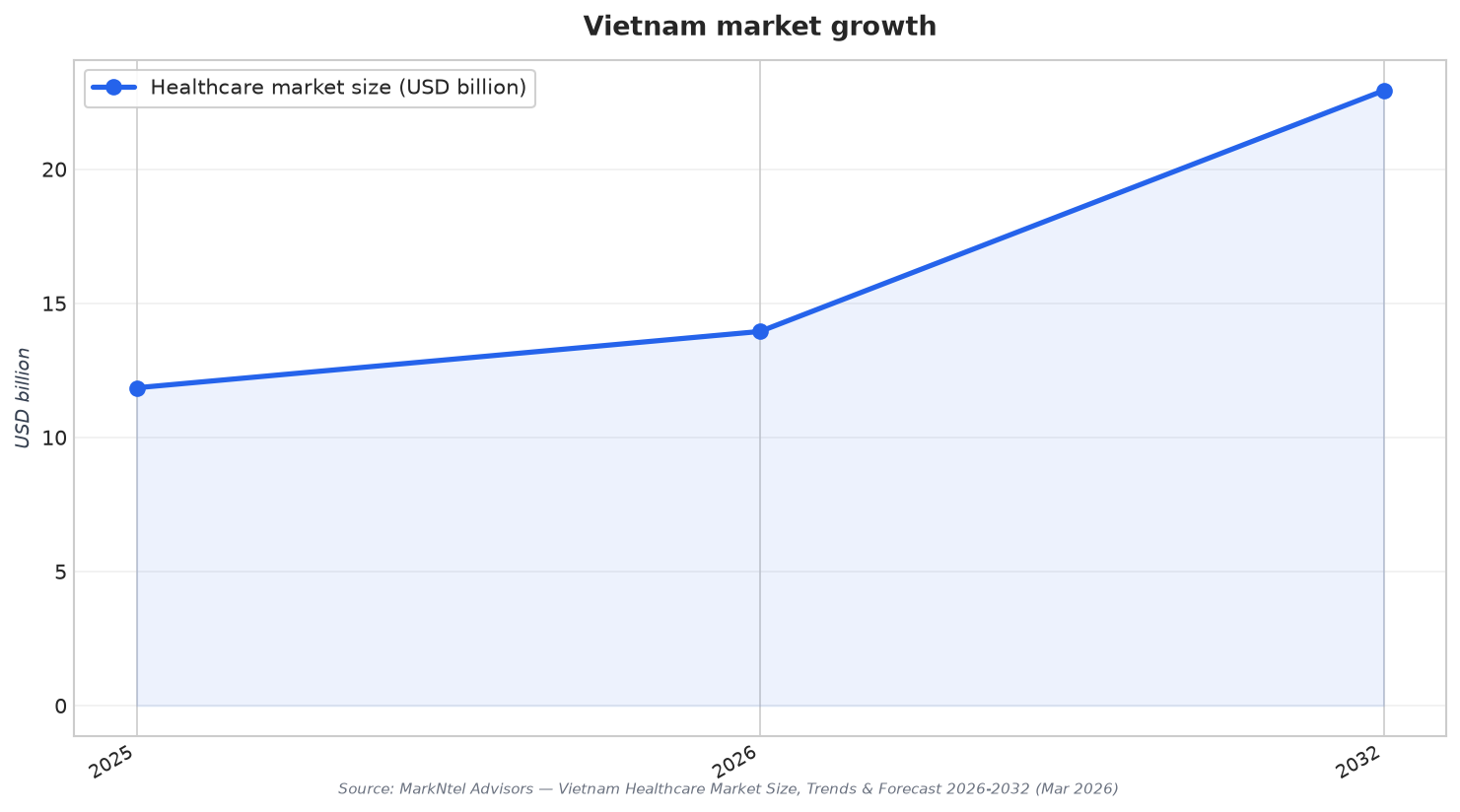
Vietnam’s healthcare landscape is growing, but the central challenge is not only scale. It is how to make spending translate into better health. One market outlook values Vietnam’s healthcare market at USD 11.85 billion in 2025 and projects growth from USD 13.95 billion in 2026 to USD 22.93 billion by 2032, a projected 8.64% CAGR during 2026–2032. In parallel, the system is described as moving through structural reforms and investment in service quality, supported by national agendas focused on disease prevention, strengthening primary care, and digital transformation. This context is where Value-Based Healthcare Vietnam discussions fit: shifting attention from counting services to measuring what care achieves.
Needs on the ground also point toward outcome-focused models. The same Vietnam market outlook notes that about 25% of patients in Vietnam’s healthcare system in 2026 were affected by cardiovascular diseases, and cancer impacted approximately 35% of the patient population in 2026. Capacity is substantial, with 1,718 hospitals and over 350,000 beds reported in Vietnam’s healthcare infrastructure. Yet access and affordability pressures remain part of the picture. A U.S. government country guide notes that patients continue facing challenges over medical access and increasing out-of-pocket healthcare costs, with large regional variations in the number of healthcare facilities, doctors, and beds between rural and urban regions.
What “Value-Based” Requires: Measurement, Incentives, and Tools
Value-based healthcare is commonly defined as measuring health outcomes against the cost of care, and shifting reimbursement away from fee-for-service volume toward improving health and quality of life. A Roche perspective emphasizes that counting visits or tests is easy but does not show whether care improved a person’s life, and points to patient-reported outcome measures (PROMs) as tools for capturing what matters to patients. It also highlights that achieving this vision requires collecting robust outcome data, reorganizing services around patient needs, and aligning financial incentives. For Vietnam, this frames a practical agenda: build consistent outcomes measurement and use it to guide procurement, care design, and payment decisions.
Technology and supply realities influence how quickly outcomes-based care can scale. Vietnam’s medical device market was valued at USD 1.9 billion in 2024 and is forecast to grow at an 8.2% CAGR from 2024–2029 to reach USD 2.8 billion by 2029, according to BMI Research cited in the U.S. country guide. That same source states around 90% of medical equipment in Vietnam is imported, and Vietnam imports approximately 60% of pharmaceutical end-products and 90% of active pharmaceutical ingredients used in drug production. These inputs matter for value-based models because outcomes tracking often depends on reliable diagnostics, monitoring, and consistent availability of therapies across sites.
Global value-based care trends offer useful comparison, but they are not Vietnam-specific facts. Mordor Intelligence estimates the global value-based healthcare services market at USD 2.27 trillion in 2026, with North America holding a 45.90% share in 2025, and Asia Pacific expected to record a 25.20% CAGR over the forecast period. It also reports shared savings programs leading with a 30.74% revenue share in 2025 and capitation/global budgets projected to expand at a 19.02% CAGR through 2031. For Vietnam, the takeaway is directional: outcome-linked payment models can take multiple forms, but they all depend on credible data, coordinated care, and incentives that reward results rather than volume alone.
What does value-based healthcare mean in practical terms?
Why is Vietnam discussing a move from volume to outcomes now?
What disease areas highlight the need for outcomes-based care in Vietnam?
How can Vietnam measure outcomes beyond visits and tests?
What is driving Value-Based Healthcare Vietnam capabilities in devices and medicines?