Health worker mobility tied to the Philippines is no longer only a national workforce issue. It is becoming a design constraint for how nearby health systems plan staffing. OECD reporting on migration to OECD countries shows Asia as the main region of origin, accounting for about 40% of foreign-born doctors and 37% of foreign-born nurses working in the OECD. Within those flows, the Philippines is identified among the top three countries of origin for nurses, alongside India and Poland. The same OECD discussion also notes that some destination systems depend on international hiring to address domestic shortages, particularly in hospitals, and describes Ireland’s Health Service Executive running recruitment campaigns that target the Philippines and India. This sustained demand pushes employers toward repeatable cross-border hiring playbooks.
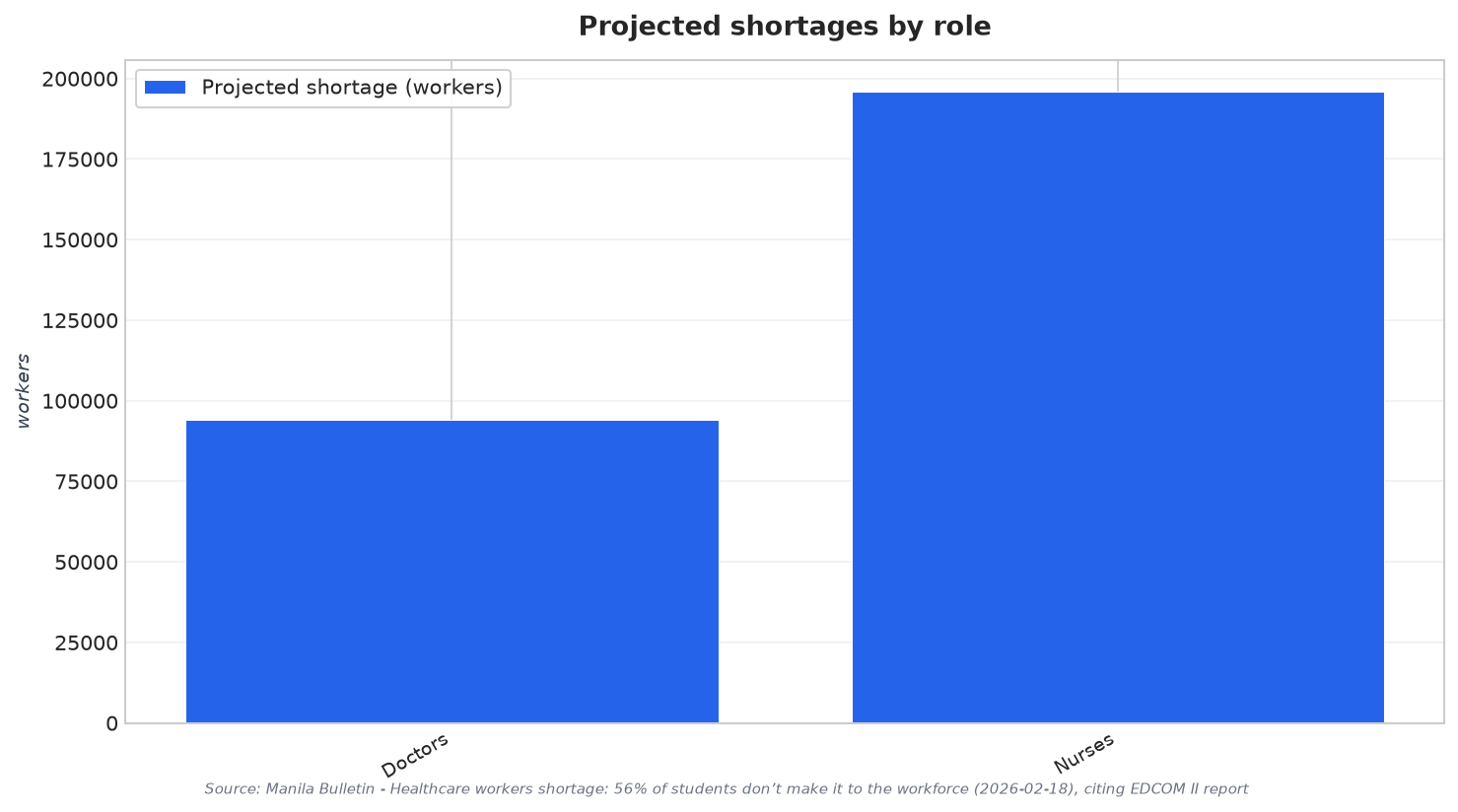
Inside the Philippines, workforce arithmetic explains why outbound movement can quickly become a staffing problem, not just a labor-market feature. EDCOM II reports the country has 21.2 healthcare workers per 10,000 people, which it says is less than half of the WHO benchmark of 44.5. In the same assessment, the Philippines faces a shortage of about 290,000 healthcare professionals needed to meet population needs. EDCOM II also describes a “leaky” education pipeline: roughly 56% of students entering healthcare degree programs, or about 33,000 individuals annually, never reach the workforce. It cites about 15,000 estimated dropouts yearly and about 11,000 estimated licensure exam non-passers out of roughly 26,000 graduates, resulting in about 32,000 licensed graduates each year. That output is described as almost equal to the estimated 27,000 healthcare professionals leaving the country annually.
How Mobility Pressures Could Reshape Staffing Models Across the Region
As demand persists in multiple destinations, staffing models are likely to adapt toward more structured cross-border pathways. A BusinessMirror report summarizing a study that used Philippine labor market data, policy analysis, and interviews with migration experts and Filipina migrant workers in Japan, Singapore, and Australia points to a growing paradox: destination countries increasingly rely on Filipino workers to care for aging populations, while continued migration could leave the Philippines facing its own shortages. The study recommends specific building blocks that align with scalable staffing models: cross-border recognition of professional qualifications, portable social protection and healthcare benefits, ethical recruitment, continuous skills development and digital training, and stronger bilateral agreements between the Philippines and destination countries. These are operational levers for health systems that need predictable supply without destabilizing source-country services.
Domestic maldistribution makes the impact of migration uneven and can intensify the push for regional staffing solutions. EDCOM II highlights that the production of healthcare workers is skewed toward the private sector and concentrated in urban centers. Out of 80 medical schools, only 28 are public universities, and Region 10 and the Cordillera Administrative Region are cited as lacking a public medical university. Dentistry access is also described as limited: only 34 dental schools exist nationwide, with 10 (29%) clustered in Metro Manila, and 12 regions, including BARMM, MIMAROPA, and Region V, having virtually no access to dental education providers. In service delivery, EDCOM II notes 3,300 Department of Health plantilla positions remain unfilled, leaving government hospitals and rural health units chronically understaffed. Separate analysis on outmigration and distribution adds that less than 25% of municipalities meet WHO health workforce density recommendations, underscoring local gaps even before overseas demand is factored in.
Employer expectations also shape what staffing models must deliver. A qualitative study of 14 former healthcare professionals from a government hospital in Leyte reports migration motives that include professional and career growth, a better work environment, competitive compensation, concerns about the Philippine healthcare system, and mental wellbeing. Another policy-facing lens comes from the outmigration paper noting that in 2019, 17,000 Filipino nurses signed overseas contracts, and that poor compensation and working conditions were key drivers. Together, these signals suggest that any sustainable response to Health Worker Migration Philippines dynamics will require not only recruitment pipelines, but also retention-focused reforms and clearer career pathways, especially in public hospitals and underserved areas.
What do OECD findings suggest about the Philippines’ role in nurse migration to OECD countries?
What does EDCOM II say about the Philippines’ healthcare worker density and shortage?
How leaky is the healthcare education-to-workforce pipeline, according to EDCOM II?
What practical staffing-model ideas are recommended for cross-border care work in the Asia-Pacific?
How can Health Worker Migration Philippines pressures affect public health staffing locally?