
South Korea is building the foundations needed for AI to work across real clinical environments, not just in pilots. The Ministry of Health and Welfare (MOHW) has assisted hospitals since 2020 in establishing data infrastructure and using health data for medical research and better healthcare services. In early 2023, the MOHW launched a data utilisation project that supports digital health researchers by giving them access to data from partner hospitals. Alongside these steps, the government is expanding public health and medical data infrastructure while also supporting hospitals in adopting AI, aligning policy and operational capability rather than treating them as separate tracks.
A major policy direction is integrating data that historically lived in separate systems and institutions. One current project under the Health and Medical Data Policy Deliberation Committee is linking clinical data from three national university hospitals to the Health and Medical Big Data Platform, which already holds administrative data from public institutions. KoreaBioMed also reports a plan to integrate clinical data from national university hospitals into the Healthcare Big Data Platform that aggregates administrative data from public bodies. This shift is central to the National Health Data Platform South Korea agenda, because AI tools struggle when datasets are incomplete, siloed, or hard to access for legitimate research use.
Why “AI-Ready” Now Means Interoperability, Cloud, and GPUs
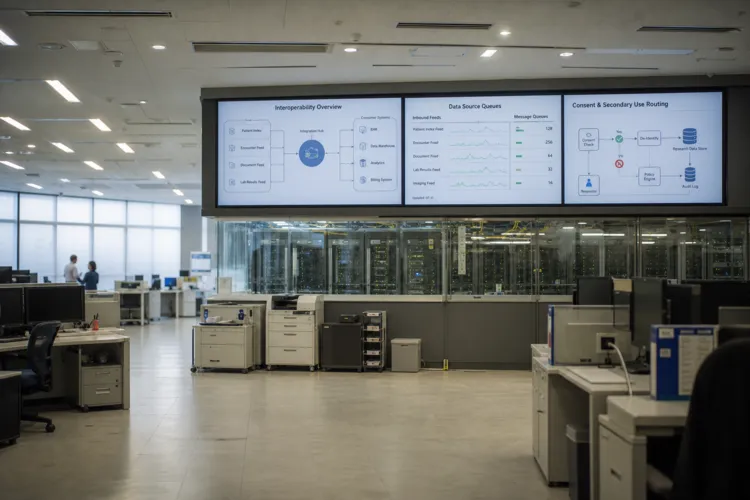
Recent reporting highlights why infrastructure is the gating factor for scaling clinical AI. A 2026 analysis cited by TechTimes estimated that 70% to 80% of hospital AI pilots fail to scale because data is fragmented across incompatible systems, such as electronic health records, radiology archives, laboratory information systems, and nursing platforms. In response, KT and Seoul National University Hospital signed an infrastructure-focused partnership aimed at creating a shared AI and cloud substrate so multiple clinical AI tools can run without each building its own data pipeline. Separately, South Korea’s “AI Basic Healthcare Strategy,” adopted in August 2026, set a “Public Healthcare AI Highway” to connect nine regional public hospitals to a shared national AI platform in the second half of 2026 and reach all 72 hospitals by 2029.
Compute and cloud services are also being positioned as public research enablers. Healthcare IT News and KoreaBioMed report that the Korea Disease Control and Prevention Agency’s National Institute of Health manages national healthcare R&D data via the Clinical and Omics Data Archive (CODA). By 2026, it aims to secure graphics processing units (GPUs) and enhance cloud services to deliver an advanced analytics system for remote analysis of large datasets for public researchers. In parallel, the National Cancer Center Korea is setting up public cancer and clinical data libraries covering eight cancer types and is planning to build a national cancer big data platform and precision medicine infrastructure, reinforcing the role of specialized libraries alongside broader public-clinical platforms.
Market momentum adds pressure to get the data layer right. Grand View Research estimates South Korea’s AI in healthcare market generated USD 584.5 million in 2025 and is expected to reach USD 10,119.7 million by 2033, with a projected CAGR of 42.9% from 2026 to 2033. It also estimates that software solutions had an 83.15% revenue share in 2025, and that South Korea accounted for 1.6% of the global AI in healthcare market in 2025. Against this backdrop, KoreaBioMed notes a ₩6.3 billion national project for Yonsei researchers to develop AI that automates nursing records, showing how applied use cases are being funded as the data access and analysis environment improves.
What is South Korea doing to make health data AI-ready?
Why do many hospital AI pilots fail to scale?
What is the “Public Healthcare AI Highway” in South Korea?
How is the KDCA upgrading remote analysis for researchers?
How fast is South Korea’s AI in healthcare market expected to grow?