India’s retail pharmacy market is expanding in size and changing in structure at the same time. Credence Research values the India Retail Pharmacy Market at USD 14,054.67 million in 2018 and USD 23,959.34 million in 2024, and anticipates it could reach USD 50,883.42 million by 2032 at a CAGR of 9.20%. This growth backdrop matters because scale creates incentives to simplify how medicines move from factories to counters. Drivers cited include expanding organized retail chains, rapid digitalization, growing adoption of e-pharmacy platforms, and improved logistics networks that lift availability in urban and semi-urban areas.
The distribution layer beneath retail is also a consolidation story in progress. A Substack analysis on Indian pharma distribution describes more than 60,000 distributors in India, many of them family businesses serving a city with a godown and a few vans. The same source cites the Indian Pharmaceutical Alliance estimate that organized players held about 10% of the distribution market in 2023, with expectations of 25% to 30% by 2030. It contrasts this with the US, where 3 companies move over 90% of all drugs, as a benchmark for what a more concentrated system can look like. The argument is straightforward: if trade shifts from many small stockists to fewer scaled operators, supply becomes more centralized.
What Consolidation Changes at the Pharmacy Counter
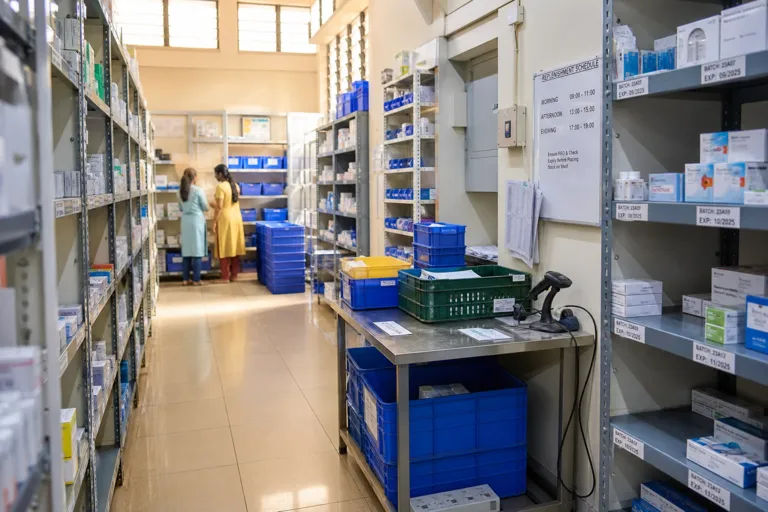
Consolidation is not just a corporate narrative; it shows up in how pharmacies source and stock medicines. The distribution source explains why: doctors in India prescribe by brand, so pharmacies must stock thousands of brands from hundreds of manufacturers. A local stockist typically carries 10,000 to 15,000 SKUs from 30 to 40 companies, while an organized distributor can carry 50,000 to 60,000 SKUs from 300 to 400 companies. When smaller distributors lack the full list, pharmacies buy from several stockists daily to fill gaps. A more consolidated supply model can reduce these gaps by aggregating more inventory in fewer, higher-capability nodes.
Policy and margin mechanics are adding pressure for change, especially in sensitive categories. The National Pharmaceutical Pricing Authority published a gazette notification on 17 October 2026 capping trade margins on 137 cancer drugs at 30%, and from 9 November, retail prices on some of them are expected to fall by up to 70%, according to the distribution analysis. The same source notes that the Drug Price Control Order of 2013 fixes the retailer’s margin at 16% of the price to retailer on price-controlled drugs. For the 82% of medicines outside price control, it describes typical conventions of about 10% to the stockist (on PTS) and about 20% to the retailer (on PTR), with GST referenced at 5% in its ₹100 strip illustration. These details matter because they shape who can profitably invest in systems, compliance, and inventory depth.
Retail modernization is happening alongside this supply shift, and it is supported by dense national reach. Market Data Forecast cites that as of 2023, India had over 800,000 registered retail pharmacies, according to the Pharmacy Council of India, supporting OTC accessibility across urban and semi-urban regions. Credence Research adds that prescription drugs dominate with about 48% share, while over-the-counter medicines and nutraceuticals jointly contribute around 36%. Regionally, it reports Southern India at 32% share and Western India at 27%, while Northern India accounts for 24% and is described as the fastest-growing region. As organized retail pharmacy in India expands, consolidated distribution and better logistics can turn that footprint into more consistent availability, especially where pharmacy networks are growing in Tier II and Tier III cities.
How fast is India’s retail pharmacy market expected to grow through 2032?
What is changing in Indian pharma distribution, and why does it matter?
How does an organized distributor differ from a local stockist in SKU coverage?
What margin action did NPPA take on cancer drugs in October 2026?
What does the move toward organized retail pharmacy in India mean for medicine availability?