
Indonesia’s hospital market is utilization-led. Revenue is generated through inpatient, outpatient, emergency, diagnostic, procedural, and specialist episodes across public and private facilities. National coverage is now the structural demand engine: JKN enrolled 282.7 million people in 2025, equal to 98.62% of the population, and another source cites 283 million participants, or 99.34%, by October 2025. This scale supports referral volumes, while private insurance and self-pay demand increase the commercial value of complex care. The result is a setting where private providers can expand not only beds, but also specialist programs and higher-intensity services.
Market forecasts reinforce the idea that the next phase is about case mix. Ken Research values the Indonesia hospital market at USD 17,660 Mn in 2025 and projects an 8.0% CAGR during 2025–2032, rising to USD 28,025 Mn in 2031 and USD 30,267 Mn by 2032. That growth is expected to outpace a modeled 4.5% expansion in inpatient admissions because revenue per episode rises with specialist case mix, diagnostic intensity, premium private capacity, and more complex cardiovascular, oncology, nephrology, and neurological treatments. In this context, private growth strategies naturally tilt toward specialties that lift revenue per episode and build integrated referral networks.
Java Concentration Creates Both Scale and Whitespace
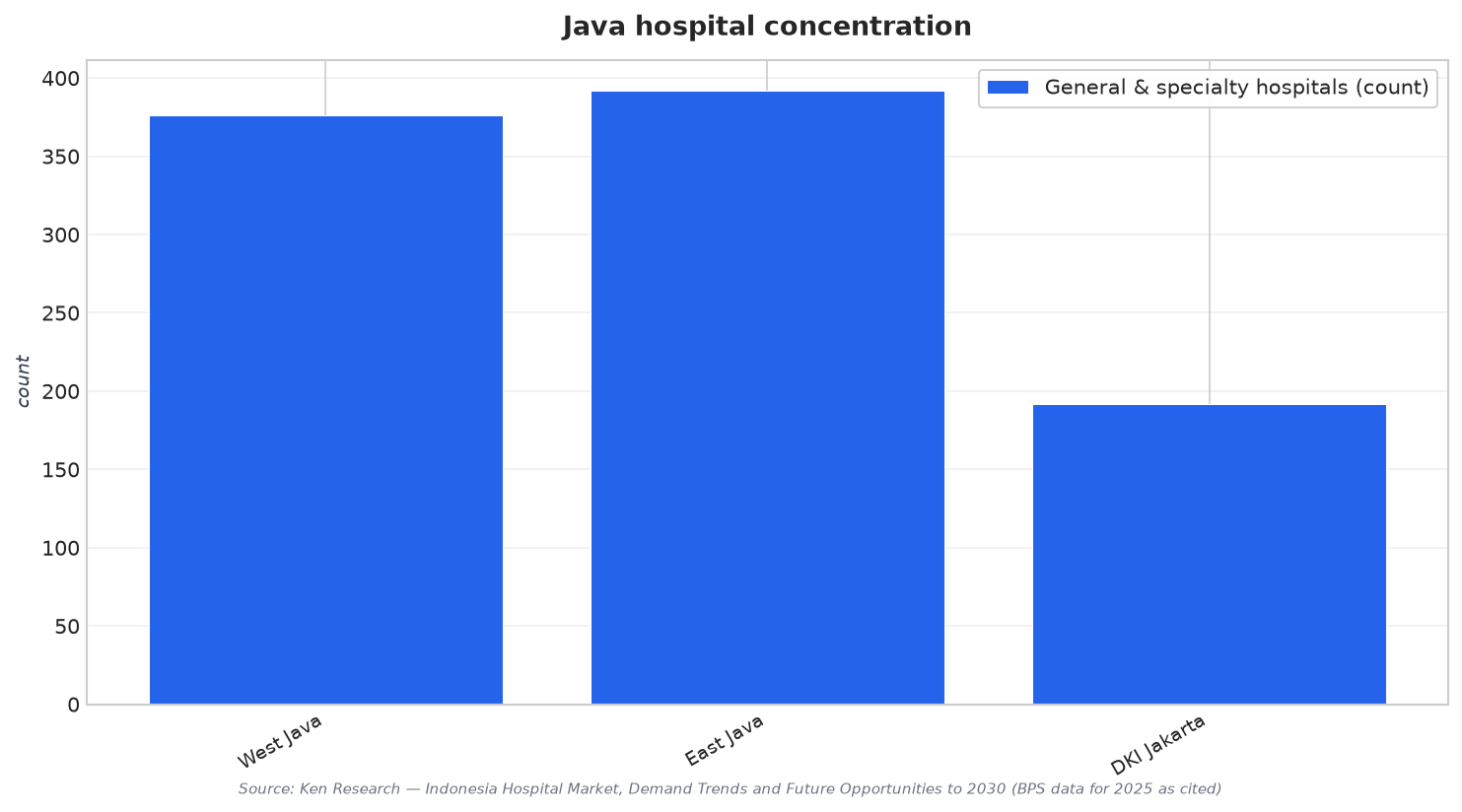
Supply remains concentrated along Java’s major population and economic corridors, shaping how private networks expand. BPS data for 2025 lists 376 general and specialty hospitals in West Java, 392 in East Java, and 192 in DKI Jakarta. This concentration supports denser specialist networks, stronger corporate insurance demand, and superior utilization economics, but it also leaves whitespace for upgraded referral capacity outside Java. Wider access constraints still show up in system indicators: Ken Research reports 1.2 hospital beds per 1,000 people in 2023, and notes that 45% of the population resides in rural and remote areas where access remains uneven. Private expansion therefore has to balance urban scale with the economics of reaching underserved districts.
Payment patterns also help explain why private hospitals can push specialty care while still chasing volume. Ken Research estimates that 32% of healthcare payments in 2024 were paid out-of-pocket, citing coverage gaps and limits in services under JKN. Meanwhile, the insurance layer on top of JKN is growing, with Mordor Intelligence valuing Indonesia’s health and medical insurance market at USD 1.63 billion in 2025 and projecting growth to USD 2.54 billion by 2031 at a 7.48% CAGR. Public and social security schemes led with a 71.62% share in 2025, while private medical insurance is projected to expand at a 9.02% CAGR through 2031. This mix encourages private providers to package faster access and advanced specialty pathways for employers and self-pay patients, while still serving insured flows.
Specialty-led expansion is also being reinforced by policy and medical tourism positioning. The Ministry of Health has a program to upgrade 66 regional hospitals, and Ken Research notes that private greenfield capacity and international hospital collaborations should expand addressable referral demand through 2032. In Bali, Bali International Hospital announced global partnerships in the Sanur Health Special Economic Zone on April 26, 2025, including the launch of the Icon Cancer Center, which began operations in May; for the first time, foreign doctors are permitted to practice in Indonesia under SEZ regulations. IMARC also notes that 60% of outbound patients were from Jakarta, prompting government investment in domestic medical infrastructure. Together, these signals point to private expansion that competes on specialty depth, not only facility count.
What is driving private hospital expansion in Indonesia toward specialty care?
How concentrated is hospital supply on Java?
What key figures describe Indonesia’s hospital market growth outlook?
How much of healthcare spending is out-of-pocket in Indonesia?
How is Private Hospital Expansion Indonesia linking to medical tourism and international partnerships?