

The Preventive Health Ecosystem China conversation is being pulled forward by a broader global pivot: prevention is increasingly framed as an “upstream” strategy rather than an occasional screening event. In one global forecast, the preventive medicine market is estimated at USD 420.00 billion in 2025 and is projected to rise from USD 454.02 billion in 2026 to about USD 915.18 billion by 2035, expanding at a CAGR of 8.10% from 2026 to 2035. Another estimate places the preventive medicine market at USD 442.27 billion in 2026, projecting USD 800.2 billion by 2034 with a 9.1% CAGR. These are global figures, but they help explain why early detection, risk reduction, and prevention-first service design are now treated as strategic priorities.
For China and the wider region, the most relevant directional signal in these sources is the Asia-Pacific growth expectation. Precedence Research projects Asia Pacific will grow at the fastest CAGR of 9.5% during its forecast period, while Mordor Intelligence also points to Asia-Pacific as the fastest-growing region, forecasting a 13.65% CAGR through 2031 (with North America leading revenue share in 2025 at 41.87%). These sources do not break out China-only totals, but they do show the region’s momentum alongside a structural change in how prevention is delivered: more continuous monitoring, more digital touchpoints, and more routine integration of screenings into front-line workflows.
What “Early Intervention” Looks Like in Practice: From Screening to Continuous Monitoring
Across the cited reports, early intervention is shifting from episodic checkups to always-on or near-real-time prevention. Future Market Insights describes a move from episodic screening toward continuous, digitally enabled health monitoring that integrates screening data with predictive analytics. Precedence Research describes AI as enabling early diagnosis and personalized care by analyzing electronic health records, wearables, and diagnostics to identify risk patterns before symptoms appear, while also highlighting chatbots and virtual assistants that can provide health and lifestyle guidance. This is supported by technology-market dynamics in Mordor Intelligence, which forecasts remote and virtual channels growing at 14.89%, compared with 7.56% for in-person modes, and notes sensor miniaturization and battery advances that expand consumer-grade devices meeting clinical-grade accuracy standards.
The mix of services and settings is also changing, which matters when thinking about an ecosystem approach rather than a single product category. In the global preventive medicine market, Precedence Research lists vaccines as the dominant type with a 35% share in 2025, while screening and early detection is the second-largest segment and is expected to expand at a 9.5% CAGR from 2026 to 2035. It also reports hospitals and clinics led end-use with a 40% share in 2025, while diagnostic centers are projected to grow at a 9% CAGR between 2026 and 2035. Future Market Insights adds that screening and early detection services held 34.7% of the service type segment in 2026. Taken together, the “ecosystem” signal is clear: prevention is being built across sites of care, with screening, immunization, and digitally supported behavior change increasingly linked.
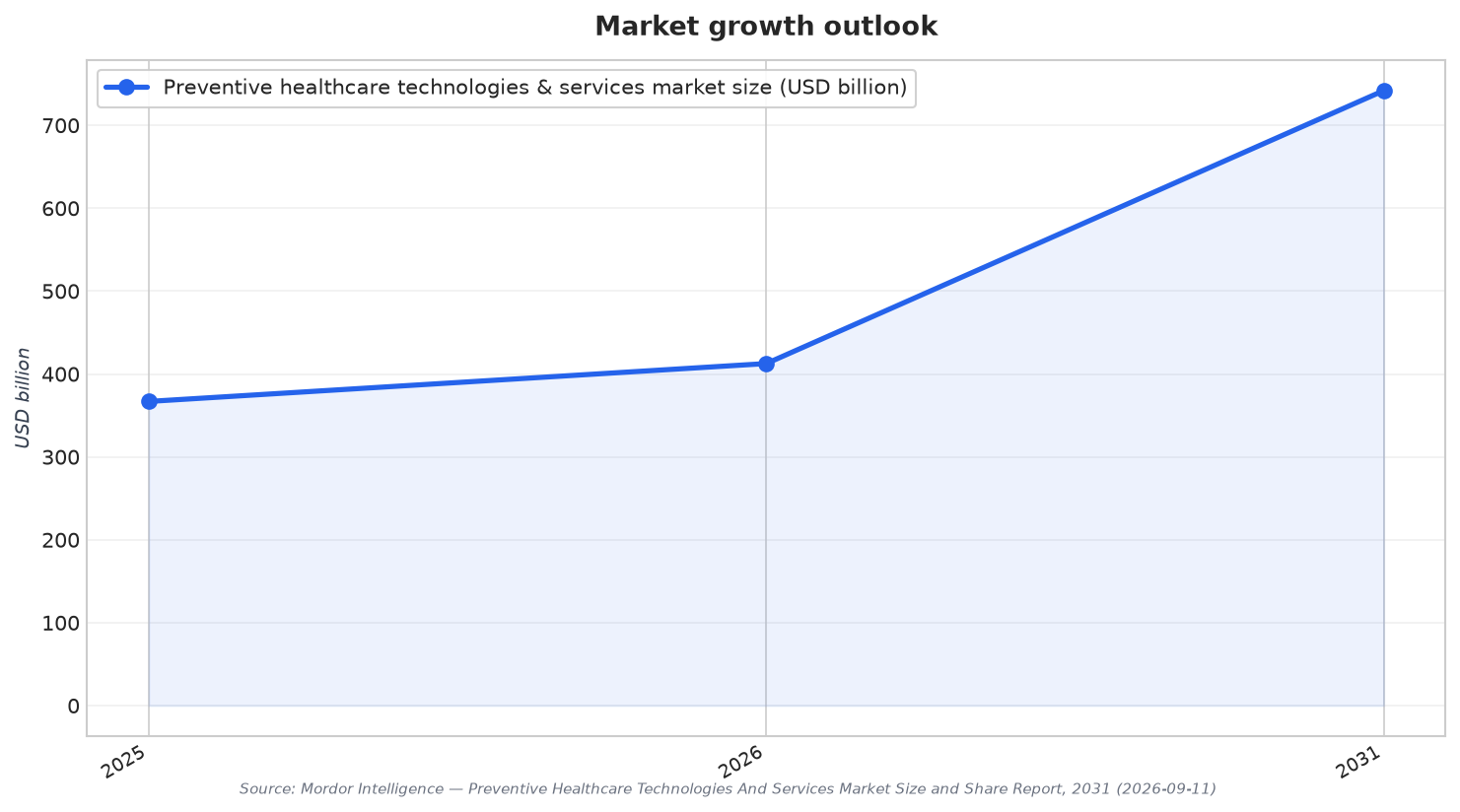
Technology and services forecasts reinforce why early intervention is gaining budget and product attention globally, providing context for China-focused strategy. Mordor Intelligence projects the preventive healthcare technologies and services market to expand from USD 366.91 billion in 2025 and USD 412.59 billion in 2026 to USD 741.85 billion by 2031, at a 12.45% CAGR from 2026 to 2031. DataM Intelligence, via an openPR release, values the same market at US$ 297.66 billion in 2025 and projects US$ 941.11 billion by 2035, growing at a 12.2% CAGR from 2026 to 2035. Within this category, Mordor Intelligence reports products captured 64.92% share in 2025, while services are projected to grow at a 14.76% CAGR through 2031, and it expects the individuals segment to grow at a 15.45% CAGR through 2031. These global patterns underline a practical takeaway for any China prevention roadmap: early intervention is becoming more remote, more service-led over time, and more consumer-involved.
What signals a shift toward early intervention in China’s preventive health ecosystem?
How fast is Asia-Pacific expected to grow in preventive health markets?
Which preventive medicine segments stand out in the forecasts?
What delivery channels are forecast to grow faster: remote or in-person prevention?
How does the market balance products versus services in preventive health technologies?