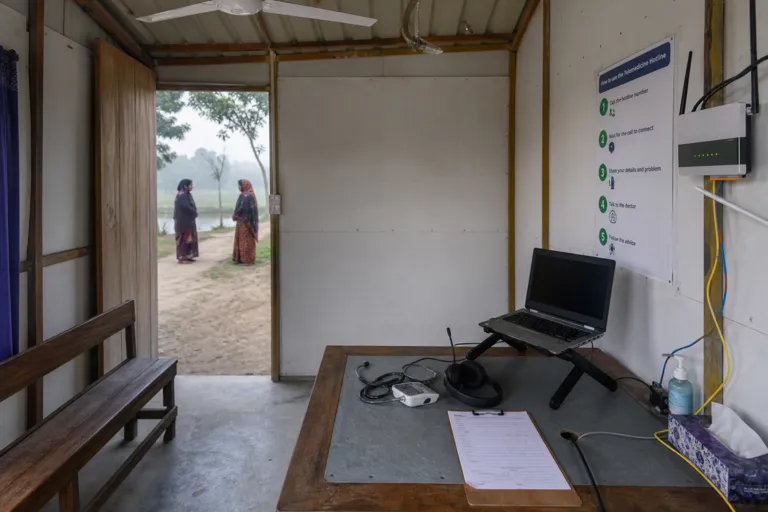
For many families outside Dhaka and Chattogram, basic care can mean long travel, high cost, and lost workdays. The case of a 58-year-old farmer from Rangpur who called Bangladesh’s national health helpline at 16263 and spoke to a licensed doctor within minutes shows what is changing. He received a prescription via SMS, and medicine arrived two days later through an online pharmacy. That kind of experience reflects a broader shift: digital health is moving clinical advice closer to villages, instead of forcing patients into crowded urban hospitals for every consultation.
The need is structural, not just personal. One source describes Bangladesh as having one of the highest population densities in the world while its doctor-to-patient ratio remains below WHO recommendations. Another cites a scarcity level of about 6 doctors per 100,000 people, and multiple sources emphasize that a large majority of people live outside cities, including 68.34% rural population according to the Bangladesh Census 2022. In that context, telemedicine becomes a practical bridge, using phone calls, apps, and text to connect people who used to travel for hours for short appointments.
How Bangladesh’s Telehealth Mix Reaches Rural Patients
Public services play a central role. The Directorate General of Health Services operates mobile-based health services across upazila and district hospitals, and its 24/7 “Sasthyo Batayan” hotline connects citizens to licensed doctors free of cost. The same report says the hotline handled over two million calls last year, a sign of demand at national scale. Private models add flexibility for households with limited internet access. CliniCall offers 24/7 doctor-on-call services via a toll-free number and partners with local pharmacies to distribute calling cards for people without smartphones, aiming to make consultation possible even without being online.
Telemedicine also sits inside a larger health system where the private sector is significant. A U.S. trade guide notes that the private sector delivers 70–80 percent of care, and estimates the private health sector accounts for approximately 64 percent ($1.49 billion) of Bangladesh’s total health expenditure. It also reports about 6,000 private clinics and hospitals and 12,000 diagnostic centers. That context matters because it helps explain why telemedicine platforms can grow quickly: they plug into a landscape where private delivery already fills gaps, while rural areas still often lack access to basic services.
Still, moving beyond advice into more diagnostic support is harder. A 2026 study on mobile diagnostic tools in rural Bangladesh found that only one of 30 surveyed retailers stocked mobile diagnostic equipment, despite healthcare providers expressing strong interest. The same study points to barriers such as high prices, lack of training, poor distribution, inadequate ICT infrastructure, and unreliable electricity supply, and it describes telemedicine as underutilized in clinical settings. Even so, connectivity experiments are emerging. One report says Starlink, working alongside the Grameen Health telemedicine platform and digitally connected diagnostic centers, has reached more than 1.2 million rural patients with 450,000 teleconsultations completed, pairing satellite internet with a distributed care model.
How is rural telemedicine in Bangladesh reducing the need to travel to city hospitals?
What government telemedicine service is available nationwide in Bangladesh?
Why is telemedicine demand high in rural Bangladesh?
What is holding back mobile diagnostic tools for telemedicine in rural areas?
What role does the private sector play in Bangladesh healthcare and telemedicine growth?