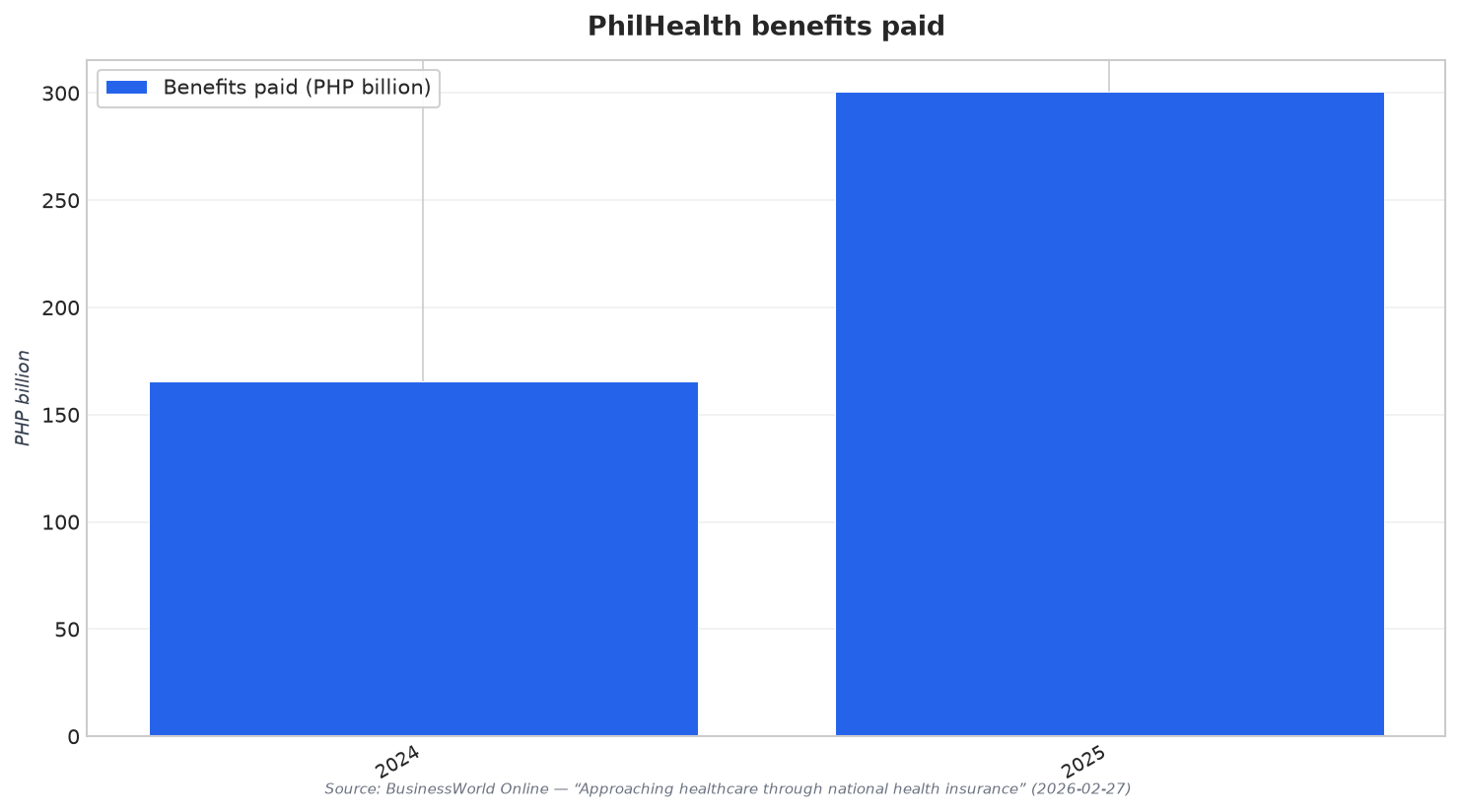
National Health Insurance Reform Philippines efforts are closely tied to PhilHealth’s National Health Insurance Program (NHIP) performance and its role under universal health care policy. BusinessWorld Online reports that PhilHealth said it reached full population coverage in 2025, with 106.24 million beneficiaries enrolled. The same report said PhilHealth paid more than P300.45 billion in benefits nationwide in 2025, nearly double the P165.34 billion released in 2024. These operational figures matter because financial risk protection is a stated objective of universal health care: the Department of Health describes this protection as making any Filipino eligible to enroll, understand entitlements, avail services, and be reimbursed by PhilHealth for health care expenditures.
The reform arc is not new, and PhilHealth points to earlier building blocks. BusinessWorld Online traces roots to Republic Act 6111, the Philippine Medical Care Act enacted in 1969 and taking effect in 1971, which placed a national medical care program under the Philippine Medical Care Commission and ran for nearly 25 years. In 1995, Republic Act 7875, the National Health Insurance Act, created PhilHealth and set the goal of social health insurance coverage for all Filipinos. PhilHealth later assumed administration of Medicare programs for government employees in October 1997, private sector Medicare accounts in April 1998, and overseas worker coverage in March 2005. Under its charter, it administers the NHIP, sets standards, manages the National Health Insurance Fund, and accredits health care providers.
What the Latest PhilHealth Numbers Say About Delivery
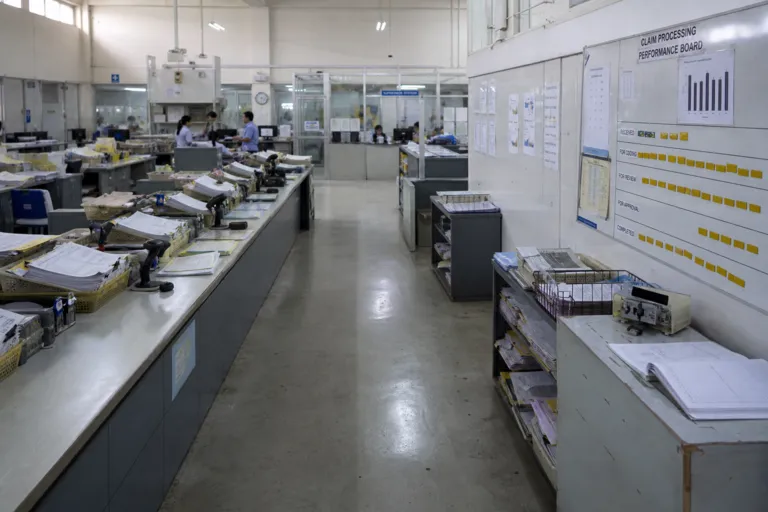
Recent transparency and claims data adds detail to how benefit delivery is functioning. BusinessWorld Online cites Department of Information and Communications Technology-PhilHealth Transparency Portal figures showing that in the first half of 2025, PhilHealth processed 9.4 million claims with a 96.8% efficiency rate and an average turnaround time of 25 days. The report notes this is above a 95% efficiency target and within a benchmark of completing processing in less than 30 days. Over the same first semester of 2025, PhilHealth collected P100.51 billion in premium contributions and paid P68.72 billion in benefit expenses as claims. It processed total claims of P139.31 billion across 9,396,020 claims, with an average value of P14,826.50 each, and cited a 68.4% benefits-to-revenue ratio.
Policy design is also pushing the system toward stronger primary care and new payment approaches. The Department of Health states that the National Objectives for Health (NOH) 2017-2022 serves as a medium-term roadmap toward universal health care, describing UHC as accessible, efficient, equitably distributed, adequately funded, fairly financed, and appropriately used care. Ken Research summarizes the Universal Health Care Act (Republic Act No. 11223), 2019 as providing citizens access to a comprehensive range of health services without financial hardship, mandating expanded health insurance coverage through PhilHealth and improvements in facilities and primary care networks. The same source notes Konsulta packages that include consultations, diagnostics, and medications up to PHP 1,700 per capita annually for registered beneficiaries. Separately, PIDS reports that in 2024 alone PhilHealth processed some 15 million claims, and a workshop with PIDS and the World Bank Group discussed using claims data to support evidence-based decisions as the Philippines transitions to a new provider payment mechanism mandated by law.
Reform momentum is unfolding alongside broader insurance market activity and persistent pressures around health costs. Markntel Advisors says the Philippines health insurance market is valued at USD 14.98 billion in 2025 and projected to reach USD 21.21 billion by 2032, citing drivers such as medical inflation exceeding 12% annually and out-of-pocket expenses hitting 50% of health care costs. The same source describes PhilHealth as the public foundation of the system and says it provides coverage to over 83 million Filipinos, while noting operational measures such as AI-enabled claims processing and prospective payment mechanisms like Diagnosis-Related Groups (DRGs). IMARC adds that the Philippines insurance market size reached USD 8.7 billion in 2025 and is projected to grow at a CAGR of 10.28% to reach USD 21.5 billion by 2034, while also highlighting regulatory reforms and digital distribution channels. Together, these signals frame a reform story where universal coverage goals depend not just on enrollment, but on faster reimbursements, better primary care, and smarter use of claims data.
What is driving national health insurance reform in the Philippines toward universal coverage?
How many beneficiaries did PhilHealth report under NHIP coverage in 2025?
How fast is PhilHealth processing claims based on recent figures?
What does the UHC Act say about Konsulta primary care packages?
Why are PhilHealth claims data becoming more important for UHC decisions?