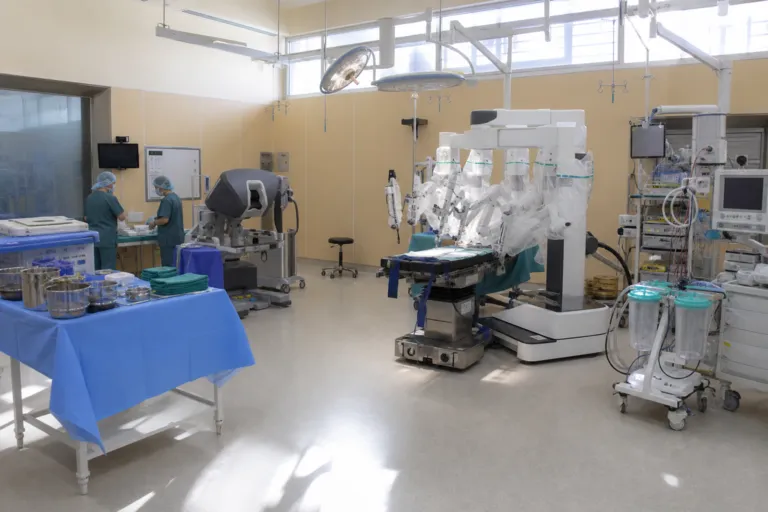
Robotic Surgery Adoption Thailand is increasingly framed as a transition, not a single leap. IndexBox describes the Thai surgical robot procedures market as moving from an early-adopter phase dominated by a few large academic centers into a broader expansion phase, driven by procedure volume growth in urology and gynecology. That change matters because it shifts decision-making away from prestige purchases and toward utilization-driven, per-procedure economics. At the same time, Thailand is described as an emerging market for healthcare technology adoption in the Asia-Pacific region, alongside China, India, and Malaysia, while Japan, Singapore, Australia, and South Korea are cited as adopting on a large scale.
Regional positioning adds momentum to Thailand’s story. UnivDatos reports that Thailand held a dominant share of the Southeast Asian surgical robotics market in 2024, linking this lead to a well-developed medical tourism industry and early adoption of medical technologies. The same source states that most major private hospitals in Bangkok and other cities invest in robotic platforms to attract international patients seeking high-quality, yet affordable, surgeries. It also notes that Thailand offers scale and visibility to businesses as a gateway to neighboring markets, reinforcing why suppliers and hospital groups may treat the country as a regional reference point rather than a niche buyer.
What Is Changing Inside Thailand’s Robotic Surgery Market
Several concrete market signals point to broader diversification and more complex segmentation. Grand View Research’s Thailand outlook states that the “others” application category was the largest segment, with a 53.37% revenue share in 2025, within a segmentation that includes orthopedics, neurology, urology, and gynecology. That mix aligns with broader descriptions of where surgical robots are most commonly employed, including gynecology, urology, orthopedics, and general and neurosurgery. IndexBox adds that installed-base density remains low relative to regional peers, implying a pull-through opportunity where instrument and service revenue can become strategically important once systems are placed and used consistently.
Operational constraints are shaping how adoption happens in practice. IndexBox emphasizes persistent budget constraints within Thai hospital capital procurement committees, which makes lease and per-procedure financing models more attractive than outright system purchases. It also identifies surgeon training and procedural proficiency as the primary bottleneck to procedure volume growth, rather than system availability, and highlights the value of local training infrastructure, simulation programs, and proctorship networks. The same report notes vulnerabilities tied to imported components such as precision motors and optics, alongside regulatory re-certification friction for design changes, which together can influence rollout speed, service readiness, and long-term reliability.
Clinical ambition and public-sector visibility are also part of the shift. UnivDatos notes that on August 8, 2025, the Faculty of Medicine at Chiang Mai University launched Thailand’s first robotic surgery system and describes it as a pioneering milestone for Southeast Asia that combines high-end medical technology with public healthcare. Separately, NCHStats reports that Thailand advances robotic surgery in 2026 with landmark heart operations, public healthcare adoption, and broad hospital programs, arguing that progress in technically demanding procedures signals readiness in infrastructure, coordination, and safety protocols. In global context, Grand View Research cites the American College of Surgeons reporting in January 2026 that more than 12 million surgeries had been performed globally using da Vinci systems, underscoring the expanding role of robotic surgery worldwide while cost-related challenges can still hinder broader adoption in tight-budget settings.
What does robotic surgery adoption in Thailand signal about surgical care?
Which application segment led Thailand’s surgical robots market in 2025?
What is described as the main bottleneck to higher robotic procedure volumes in Thailand?
Why do financing models matter for Thai hospitals buying surgical robots?
How does Thailand’s position in Southeast Asia affect the robotics market?